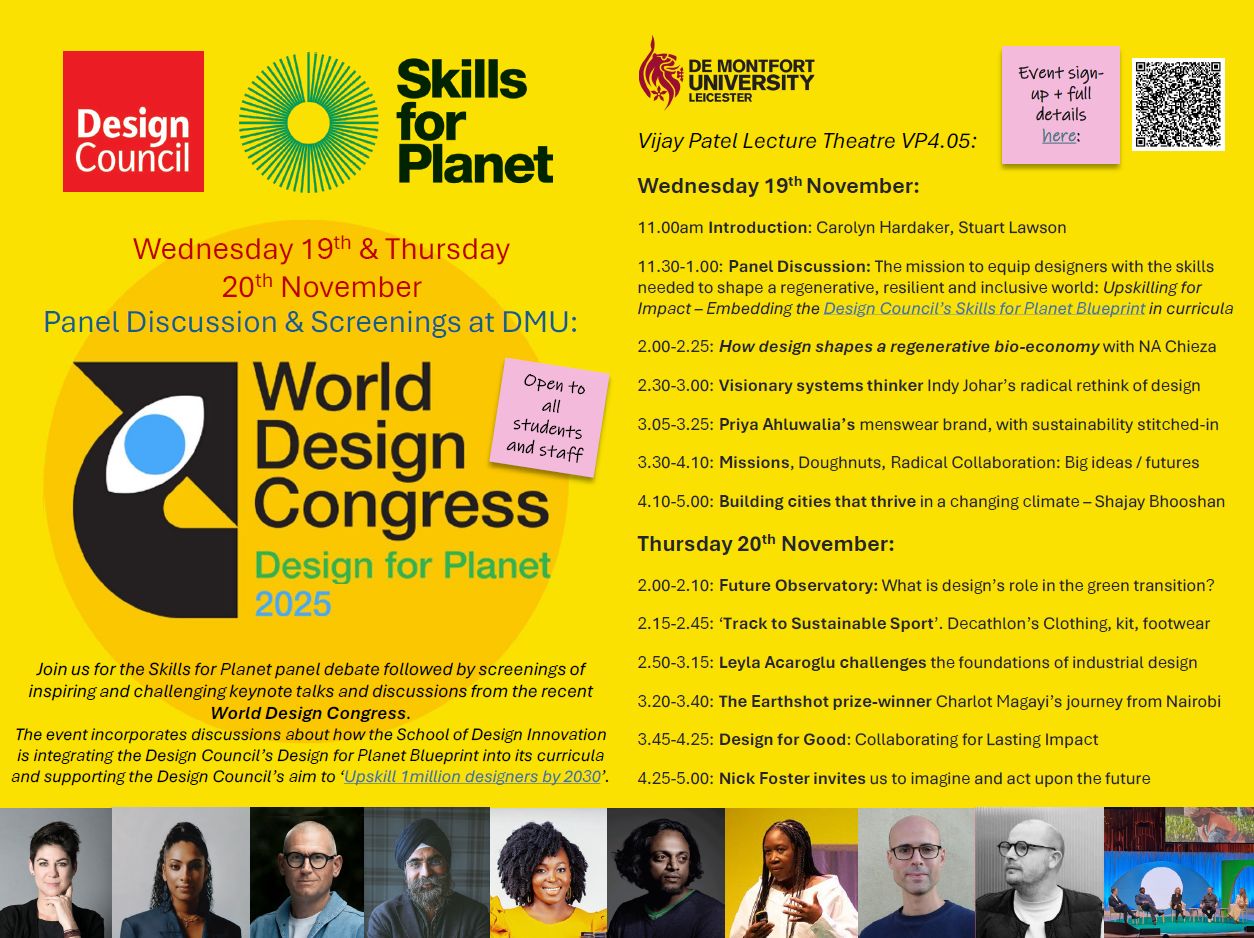
Vijay Patel Lecture Theatre VP4.05:
Wednesday 19th November:
11.00am Introduction: Carolyn Hardaker, Stuart Lawson
11.30-1.00: Panel Discussion: The mission to equip designers with the skills needed to shape a regenerative, resilient and inclusive world: Upskilling for Impact – Embedding the Design Council’s Skills for Planet Blueprint in curricula
Panellists:
• Mohammed Patel (UK Fashion and Textile Association)
• David Harris (Architect, Feilden Clegg Bradley Studios)
• Professor Claire Lerpiniere (Prof. of Sustainable textiles
• Dr Andrew Reeves (Education for sustainability and climate action)
• Ashley Clayton (Technology and Environments Lead, The Leicester School of Architecture)
• Dr Kyungeun Sung (Associate Prof. Design Innovation. Upcycling & Sustainability)
SCREENINGS DAY 1:
2.00-2.25: How design shapes a regenerative bio-economy: Stories of Hope and Possibility: Natsai Audrey Chieza and Normal Phenomena of Life: How can design shape a regenerative bio-economy? Natsai Audrey Chieza takes us on a behind the scenes journey through her future-facing biotech consumer platform – Normal Phenomena of Life – to delve into the microbial science that design turns into commercial products based on ethical value chains, as well as new research that explores deeper philosophical questions about our relationship with nature, food and soil and how it needs to be rebalanced to grow a new economy that provides value for all living things.
2.30-3.00: Visionary systems thinker Indy Johar’s radical rethink of design: Designing the Age of Stewardship: Visionary systems thinker Indy Johar invites us to radically rethink the role of design, not as a tool for creating objects, but as a practice of stewardship for shaping a just, regenerative future. Explore design’s political and economic relevance in a time of deep global transition and turbulence. From exploring post-growth economies to redefining what it means to be human, Indy will challenge extractive mindsets and make the case for design as a force for care, community, and systemic change. This is a call to action for the design economy, to step into its power, take responsibility for the futures it shapes, and act as imagineers of the future and custodians of the planet.
3.05-3.25: Priya Ahluwalia’s menswear brand, with sustainability stitched-in: Threads of Change: Fashion Future Rooted in Justice: Designer Priya Ahluwalia shares the personal and powerful journey behind her trailblazing menswear brand, where sustainability and social equity are stitched into every piece. From witnessing the realities of global textile waste in India and Nigeria to building a business that champions circularity and culture, Priya reveals what it takes to grow a creative practice that’s both commercially strong and purpose-driven. This is a story of identity, innovation, and the power of design to imagine and build a more just, regenerative future.
3.30-4.10: Missions, Doughnuts, Radical Collaboration: Big ideas / futures: Designing the Economy We Need: Missions, Doughnuts, and Radical Collaboration: This provocative session dives into the big ideas reshaping our future, showing how we not only need to re-design our products, but entire economies, business models and policies on which our systems are based. You’ll leave inspired by a new economic vision that is regenerative and inclusive, understand the need to rethink the public value of arts, culture, and design, and see a way of achieving change through missions built on radical collaboration between designers, policymakers, and industry leaders. This is where the future gets made.
4.10-5.00: Building cities that thrive in a changing climate – Shajay Bhooshan: Building More with Less: Sustainable Digital Concrete with Zaha Hadid Architects: How can we radically reduce concrete’s environmental impact while expanding its design potential? Shajay Bhooshan, Associate Director at Zaha Hadid Architects shares how two experimental structures – Striatus and Phoenix – are rethinking the use of concrete for a circular future. Developed with Block Research Group (BRG) at ETH Zurich and Zaha Hadid Architects Computation and Design Group (ZHACODE), with incremental3D (in3D), made possible by Holcim, these research projects explore how geometry, digital fabrication, and structural design can come together to place material only where it’s needed, cutting waste, eliminating reinforcement, and enabling reuse through dry assembly techniques. Bringing together architecture, engineering, and technology, this is a blueprint for interdisciplinary collaboration and a demonstration of how the three R’s – Reduce, Reuse, Recycle – can be embedded directly into the design and fabrication process. This session will conclude with insights into how these tools and methods are now being shared with industry – offering a pathway from research to real-world impact.
Thursday 20th November:
SCREENINGS DAY 2:
2.00-2.10: Future Observatory: What is design’s role in the green transition?: Stories of Hope and Possibility: Justin McGuirk and Future Observatory: What is design’s role in the green transition and how can mission-driven research support a liveable future? We are in the midst of a radical reimagining of the design economy, rooted in new materials, the stewardship of ecosystems and the power of community. Research is crucial not just in driving material and behavioural shifts but in reframing the story of the climate crisis. Drawing on insights from Future Observatory, the national design research programme for the green transition, Justin McGuirk invites us to envision a future not just of minor innovations but major narrative shifts.
2.15-2.45: ‘Track to Sustainable Sport’. Decathlon’s Clothing, kit, footwear: Decathlon’s Head of Design, Charles Cambianica talks about the company’s journey to Circularity and how the company is trying to ‘make sport closer to people’.
2.50-3.15: Leyla Acaroglu challenges the foundations of industrial design: Global Greenprints: Designing Resilient Futures: Leyla Acaroglu challenges the foundations of industrial design, calling for a bold shift from extraction to regeneration, and from control to collaboration with nature. Through systems thinking and ecological insight, she reveals how embracing nature’s interconnectedness can transform design into a force for planetary health and resilience.
3.20-3.40: The Earthshot prize-winner Charlot Magayi’s journey from Nairobi: Stories of Hope and Possibility: Charlot Magayi and Mukuru Clean Stoves: Earthshot prize-winner Charlot Magayi’s journey from the informal settlements of Nairobi to the global climate stage is a story of grassroots ingenuity. This talk reveals how accessible design, like clean-burning stoves, can reduce emissions, protect health, and improve livelihoods. Discover how community-led, women-powered innovation is scaling climate action where it’s needed most: in homes, schools, and neighbourhoods across the Global South.
3.45-4.25: Design for Good: Collaborating for Lasting Impact: How can design drive real impact for the world’s greatest challenges? Explore how Nestlé, Nedbank, and General Mills are collaborating as part of the Design for Good alliance to create open-source products and services for the UN Sustainable Development Goals. Hear how working on life-centred design projects can shift corporate culture, build new skills, and turn competition into collaboration for a more sustainable future.
4.25-5.00: Nick Foster invites us to imagine and act upon the future: Rethinking the Future: To close the 2025 World Design Congress, Futures Designer Nick Foster invites us to reconsider how we imagine and act upon the future. Drawing from his provocative new book Could Should Might Don’t, he explores the patterns of thinking we all fall into when considering what’s next, and the origins, strengths and blind spots of each. Foster will challenge the design community to move beyond strident yet simplistic visions of the future, and instead focus on what’s observable, gritty, actionable, and rooted in the everyday. A timely reflection on the power which design holds to shape the future, raise the quality of the stories we tell ourselves, and improve the things we leave behind for those who will follow.
To register click here.