Where it all began.. Encounters with Sustainability and ESD
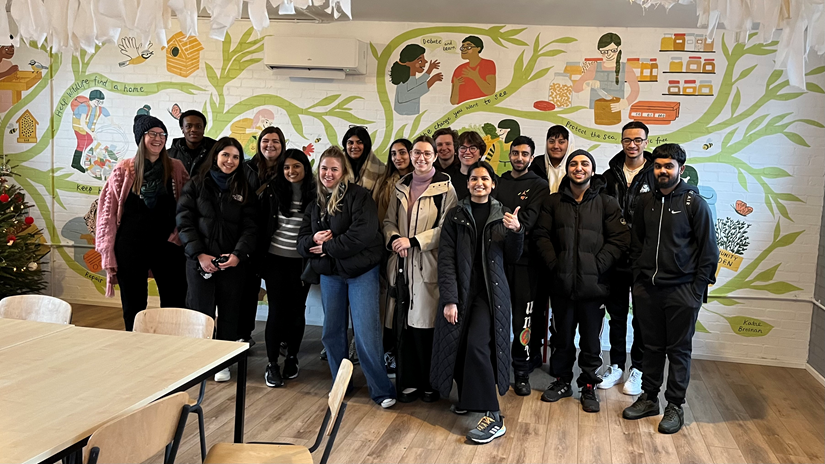
Currently, I am a Senior Lecturer in Marketing at DMU, where I teach Regulatory, Ethical and Sustainability Communications, Brand management, Marketing research and supervise PhD students.
I can trace my interest in ethics and sustainability back to my PG studies, when I became really interested in co-designing with consumers and stakeholders. Later, in my PhD, I studied how diverse stakeholders of a region can contribute to more inclusive decision-making about their place. This study ignited my interest in inclusive governance – where the most marginalised groups in society have a voice and opportunities to impact the decisions that affect them.
A colleague once said, sustainability is like a pair of glasses – a lens which transforms our view of the world. Through my many ESD engagements in the last year, I have come to realise that cultivating a sustainability mindset is not just seeing the problems, their complexities and impacts, it is about problem-solving too.
By considering, is this practice ethical? We are problematising and raising the expectations and benchmark. By considering how can we make this practice sustainable? We are looking for solutions to problems with criticality and creativity.
Sustainability Mindset in Advertising and Marketing
According to Rimanoczy and Llamazares (2021), the sustainability mindset is about connecting knowledge and skills with values. For me, sustainability mindset is criticality, creativity and collaboration in practice. My work experience in the advertising industry prompted me to reflect on the impacts of communications and actions. Advertising shapes discourse and cultures; however, its environmental and social impacts are often neglected in favour of ‘business as usual’ marketing practices. This was precisely the issue I set out to discuss and share with UG first-year students on the module ‘Regulatory, Ethical and Sustainability Communications’ (RES Comms).
My intent is that when students go out into the world of advertising and marcomms, and they face ethical dilemmas of their own, their education and experience with DMU equips them with tools and strategies to navigate these challenges. On the RES Comms module, we talk about the ethical dilemmas in marketing; however, the picture is not all bleak, and marketing can be used as a force for good – if done responsibly. The module aims for students to consider the complex issue of sustainability in marketing. With criticality and creativity, they apply theory to practice to design and deliver a positive action campaign. Students become advocates for people power and efficacy, whilst also reflecting and recognising the importance of systems changes and partnerships. Students gain experience of working collaboratively with various stakeholders at DMU: Events and Marketing team, the Student Union, and the Sustainability Hub to design and deliver their positive action campaigns.
I enjoy learning and transforming my world views with the students. Remarkably, a student on RES Comms, Catriona Cubley’s reflective blog on ‘Why Am I So Irritated At Having To Learn About Sustainability?’ helped me make sense of the ethical dilemmas I faced as a young advertising industry professional. In her blog, Catriona reflects on her struggles with climate anxiety and how structured educational materials and support on the RES Comms module helped her navigate and solve a specific problem. Her concluding words are a useful reminder, every time I feel overwhelmed:
“This lesson I will use going forwards – it doesn’t need to be all or nothing.”
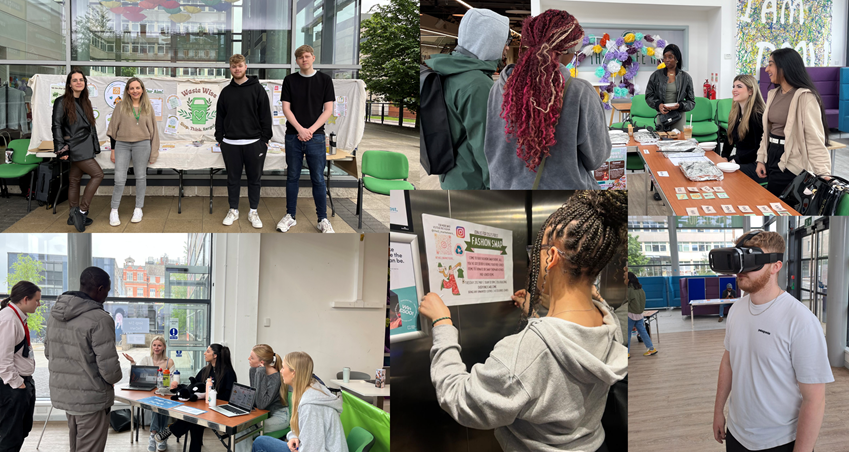
In the last three years, over a hundred RES Comms students have designed initiatives and pledge campaigns to drive individual action and advocate for systemic changes across campus on issues such as financial literacy, cleaning our seas, love nature and responsible fashion, food and energy consumption.
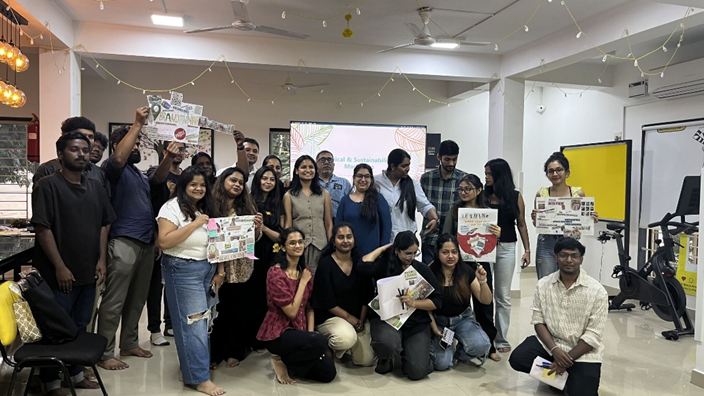
What would I say to my younger self, navigating the ethical dilemmas of the advertising world? I was able to share my thoughts in September 2025 at TING Labs, a creative advertising agency in India. Building on my previous industry engagement with Indian Creative Women for empowering women in creative leadership roles, I spent a day at TING Labs discussing ethical and sustainability mindset for marketers and advertisers, and how can we pursue ethical and sustainable marketing in practice? This question prompted advertising professionals to reflect on their personal and professional values and why sustainability matters to them.
These pledges offer a glimpse into their vision(s) for an ethical and sustainable creative agency:
🌏 Rethink ideas that cost the planet.
🫂 Reshaping the empathy effect.
📌 Prioritising fair and just moments.
🤝 Promises made are promises kept.
As an advocate for embedding sustainability in our educational curriculum and equipping our future leaders with the sustainability mindset, it was really encouraging to see that ESD matters beyond academia; it resonated with industry professionals too.
My year as ESD Co-Lead
As ESD Co-Lead since January 2025, I have led and delivered a wide range of initiatives for diverse audiences, both within and outside the university. The highlights include:
- The University ESD forum, bringing together colleagues from management, marketing and psychology to share ESD best practice,
- Faculty of BAL ESD workshops highlighting excellent teaching practices, AI integration and ESD workshop ideas,
- Induction workshop for student ambassadors on sustainable development,
- Sustainability-focused Schools Engagement event on DMU campus and
- Ethical and Sustainability Marketing workshop for advertising industry professionals in India.
There were also lots of learning and sharing opportunities as well, with the SDG Fellows, ESD Co-designs teams who launched their AI integration tool, and PRME seminars.
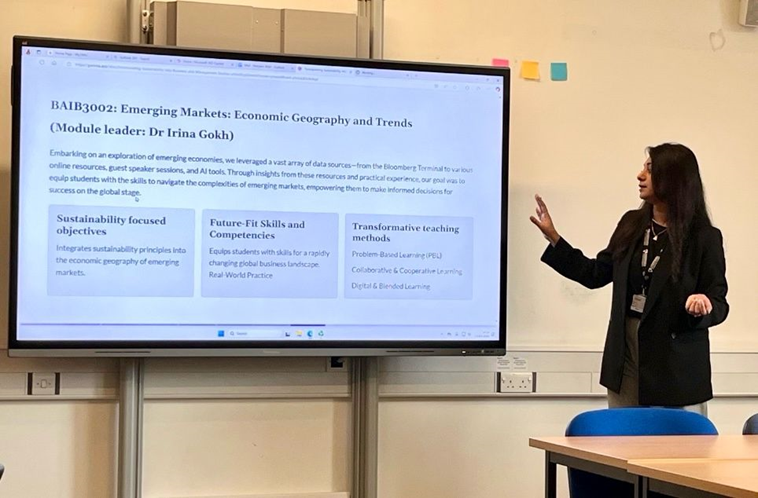
I particularly enjoyed the University ESD Forum held in February 2025, where Lis Ku and I brought together scholars from Management and Psychology to share best practices. We learnt how Dr Meryem Altaf and team are using transformative pedagogies and digital technologies to embed sustainability knowledge, skills and values on the Emerging Markets module. Dr Scott Yates shared excellent and impactful research on family mental health issues for over a decade. It was interesting to learn how he’s using the UN SDGs to frame and position his work in policy briefs and publications.
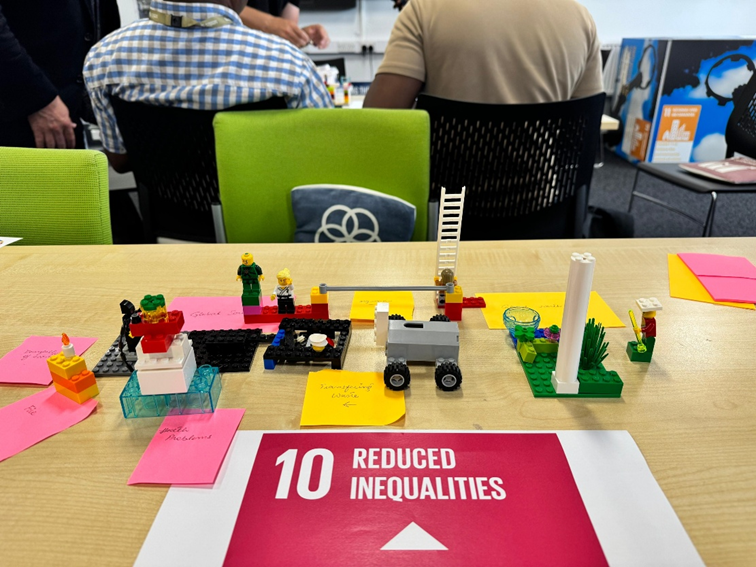
At the Faculty of BAL ESD workshop, we applied ‘play and learn’ through LEGO-building. Roger Saunders and Anoop Bhogal-Nair set the brief ‘Envision a future for UN SDG 10: Reduced Inequalities’. It was beyond fun and games! The act of building and co-creating as a team prompted deep discussions about our disciplinary knowledge of the challenges and solutions to achieve equality for all; we saw intersectionality with various other SDGs and created a collage of our plural visions for the future. I am keen to try out this activity with my RES Comms students this year!
My key takeaways this year were:
- Sustainability mindset is about problem-solving with criticality, creativity and collaboration,
- In your sustainability journey, if you feel overwhelmed, remember – it doesn’t need to be all or nothing,
- Education for Sustainable Development should embrace playful learning and games.
Going forward..
As Co-Chair for the Women’s network and Co-Lead for ESD, I see great potential to work across the themes of sustainability and equity. As Co-chair of the DMU Women’s Network, I facilitated the representation of women in the SDG11 Disaster Risk Reduction project. My efforts in this space were recognised through two University award nominations: the Climate Action Engagement Champion Award and the Strategic Delivery Award for my leadership of the EDI staff network.
A stimulating part of the co-lead role has been sharing and learning how ESD is transforming learning across diverse disciplines – from public health and immunology to computing and AI. This has strengthened my belief that with the sustainability mindset, we can critically and creatively understand the world (beyond disciplinary boundaries) and transform it too. I look forward to supporting the upcoming curriculum review, validation and QAA processes to enhance ESD integration across programmes. The ESD and Green Skills conference presents another opportunity to learn and share our successes.