Shweta Salvi & Hazel Kerr write on the outcomes of the “Deep Dives in Sustainability Education” workshops at Trinity House, De Montfort University, on the 15th and 16th October 2026.
Staff and students from across DMU participated in a series of workshops on the 15th and 16th October 2026, organised by Shweta Salvi, PhD student in the Faculty of Technology, Arts and Culture. These workshops were on the theme of Deep Dives in Sustainability Education, and covered a range of topics, pedagogies and methods to investigate relational thinking, more-than-human perspectives in nature-based solutions, and deep time/long-term planning and policy-making.
“Education can play a pivotal role in shaping nature-inclusive futures. Instead of the familiar doom-and-gloom story, these workshops focused on human capacities like long-term thinking and relational reasoning, and it was rewarding to see them resonate with participants.” – Shweta Salvi, PhD Student, Institute of Sustainable Futures
These three workshops saw participation from across DMU staff and students, strengthening the perspectives offered from a range of academic backgrounds, career stages and disciplines. Each workshop was anchored to one core human capacity and paired with several others that together were intended to activate an action.
The first workshop, ‘Who Shapes Knowledge in Higher Education?’, focused on Storytelling as a human capacity and took a deep dive into alternative educational practices and pedagogies for sustainability. The workshop also introduced Vanessa Andreotti’s HEADS-UP Tool for identifying problematic colonial patterns of modernity through two activities. The cohort was shown a short film, “The Silent Echo”, by Suman Sen, and encouraged to comment on different scenes through the lens of HEADS-UP patterns, helping participants recognise hidden colonial patterns and reflect on how these appear in education.. At the end of workshop 1, the cohort designed a novel educational curriculum, focusing on decolonial theory, accessibility and sustainability theories.
The second workshop, ‘How to be a Good Ancestor?’, focused on temporal imagination as a capacity, and delved into long-term perspectives in climate and nature theory and practice. The workshop adopted Ronan Krznaric’s 4 ways of long-term thinking and introduced concepts of the “marshmallow brain”, which focuses on instant gratification and immediate solutions, and the “acorn brain”, which focuses on systems and long-term perspectives. The workshop investigated case studies of long-term planning, a practice known as ‘Cathedral Thinking’, including the Living Roots Bridge from Meghalaya, India, Gaudí’s Sagrada Família cathedral in Barcelona, and the Svalbard Global Seed Vault. At the end of the workshop, the cohort considered ancestry looking to the future, and how to be a good ancestor in the present to future generations.
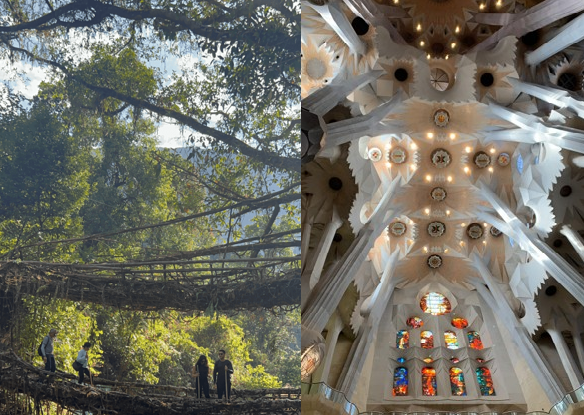
Left: The living root bridges (jingkieng jri), Meghalaya, India, ‘grown’ by Khasi and Jaintia communities. Right: Sagrada Familia, designed by architect Antoni Gaudí, has been under construction for more than a century.
Anchored in the human capacity for empathy and care, the third and final workshop, ‘How to imagine More-than-human Futures?’, investigated humanity’s relationship with nature, and what we mean by “nature-based solutions” when delivering biodiversity and nature recovery projects. The workshop began by critiquing current anthropocentric models of nature-based solutions, and proposing an alternative theory of “more-than-human” perspectives. A case study of the Trinity House herb garden at DMU was used to illustrate the relationships between native species, non-native species, visitor species and invasive species in an open natural system, with support from DMU’s Head Gardener Dan Kirk. The cohort participated in a “Council for Fellow Beings” activity, assuming the role of non-human species or natural actors to advocate for nature recovery from their perspective. Finally, a design activity of a “home garden for all species” was used to illustrate how small changes in how natural spaces are managed in domestic contexts can have large impacts on accessibility to nature.
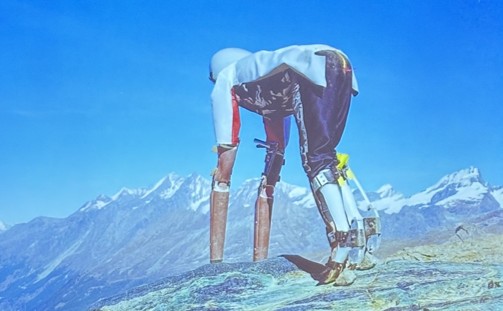
Image: GoatMan, Thomas Thwaites, who spent a week living among mountain goats in the Swiss Alps using prosthetic limbs to for movement biomimicry. Photograph: Tim Bowditch